
Wholesale Food and Beverage Suppliers in Europe: A Complete Guide for International Importers (2026)
A practical guide for importers and distributors sourcing packaged food and beverages from Europe — covering supplier checks, EU labelling rules, excise duty, customs documentation and how to get an accurate quotation.
Europe is one of the largest sourcing regions in the world for packaged food and drink, and for importers outside the EU it offers something more useful than range alone: a single, well-documented regulatory framework that travels with the goods. This guide explains how wholesale food and beverage sourcing from Europe actually works — what to check in a supplier, how labelling and shelf life are governed, why excise duty catches out first-time alcohol importers, and what a good quotation request contains.
A note on what follows. Most of this is general educational guidance on importing food and drink from Europe, and applies whoever you buy from. Where it describes what we actually supply, that is stated explicitly. Nothing here is legal or customs advice — requirements differ by destination and change over time, so confirm your own position with your customs authority or broker.
Why Europe Works as a Sourcing Base
The practical argument is regulatory coherence. Food placed on the EU market falls under Regulation (EC) No 178/2002, the General Food Law, whose Article 18 obliges every food business to operate traceability on a “one step back, one step forward” basis — they must be able to identify their immediate supplier and their immediate customer for every product. That obligation runs the length of the chain, which means a European consignment should always be traceable to its source.
Labelling is harmonised too, so a product built for one EU market is broadly intelligible in another, and the goods circulate between member states without customs formalities. For a buyer consolidating a mixed order, that matters: several sources can be brought together into one shipment before it is exported.
The second argument is depth of range. European retail carries global soft drink and energy brands, an unusually deep spirits and wine offer, confectionery, and a growing imported-Asian-food segment, often within one sourcing region and across several price tiers.
What Categories Move in Wholesale Volumes
Our own catalogue runs to 424 products, and the split below reflects how it is actually organised. Availability is confirmed per order — no line should be assumed in stock until it is quoted. You can browse the full product range for the complete picture.
Soft Drinks, Water and Energy
Soft drinks (25 products), energy drinks (19) and mineral water (7). These are the highest-rotation lines in most retail environments: recognisable, frequently repurchased, and forgiving on shelf life. They are also heavy and low-value per pallet, so freight economics matter more here than in any other category — a container of water can reach its weight limit while still half empty by volume.
Beer, Wine and Spirits
The largest part of the catalogue: champagne (54), whiskey (51), wine (40), tequila (32), beer (19), vodka (19), seltzer (16), gin (9) and cider (6). Alcohol is commercially attractive and administratively the most demanding thing you can import, for reasons covered under excise below. Treat it as a separate workstream from your ambient grocery lines rather than an extension of them.
Confectionery and Packaged Food
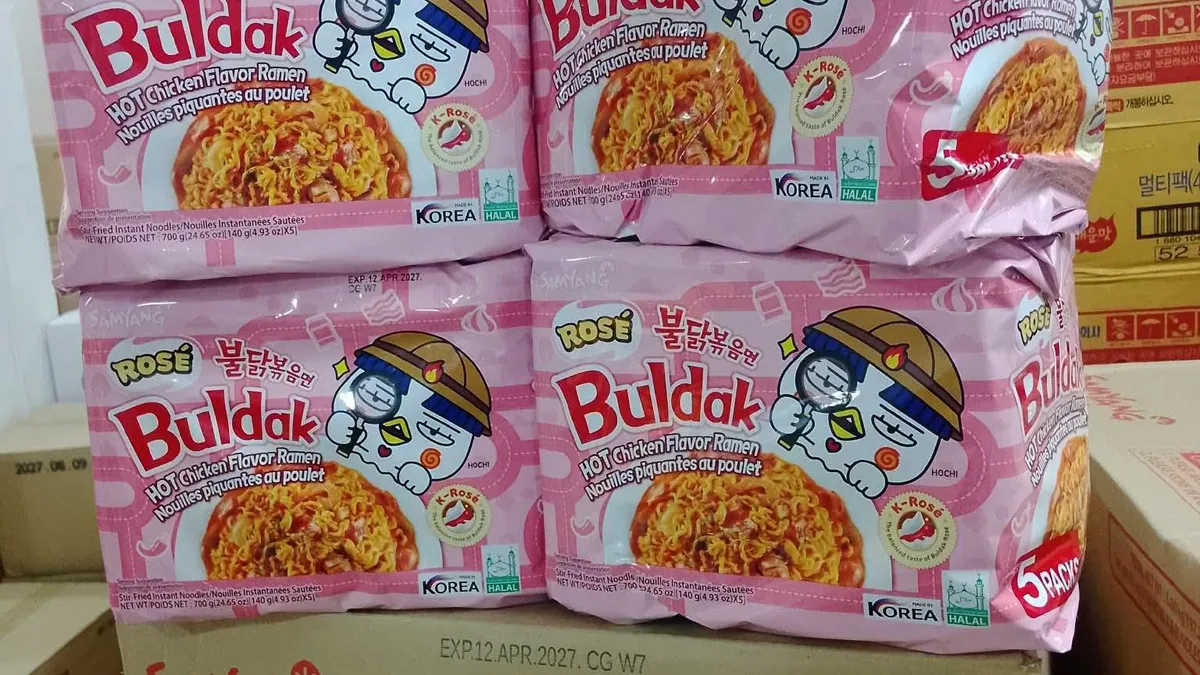
Confectionery runs to 27 products, and our Samyang Buldak noodles range to 18 lines across packet, cup and bowl formats, with South Korea as the stated country of origin and a shelf life of 10–12 months. Packaged food carries the labelling and date-marking obligations set out below, and heat sensitivity is a real planning constraint — chocolate and fried noodle blocks both suffer on a long summer routing.
Verifying a European Supplier
Food and drink attract both counterfeiting and parallel trade, so documentation matters more than a polished website. Four checks are worth making before a first order.
- The legal entity. Confirm the company behind the trading name in a public register. European companies are listed — a Polish supplier will have a KRS number, a NIP tax identifier and a registered address you can verify independently. Food & Drinks Suppliers Sp. z o.o. is registered in Poznań under KRS 0000682762.
- Traceability. Ask how the supplier satisfies its own Article 18 obligation, and how batch and lot data will be recorded for your consignment. A supplier who cannot answer this quickly is not operating a food business properly.
- Remaining shelf life. The commercially important figure is not the total shelf life but the life remaining when the goods reach you. Agree a minimum as a written term of the order — this is the single most common cause of disputes on ambient food imports.
- Terms in writing. Payment terms, claims handling, what happens on a short shipment. Our published trading terms set out how we trade; read any supplier's equivalent before the first order rather than after a problem.
Labelling and Shelf Life
Food labelling in the EU is governed by Regulation (EU) No 1169/2011, the Food Information to Consumers rules, which have applied since December 2014. See the European Commission guidance on food information to consumers for the authoritative summary. For an importer, three points carry the most weight.
Allergens must be emphasised within the ingredients list — by font, style or background colour — rather than repeated in a separate “contains” panel, which has not been permitted since 2014. If your destination market requires a different allergen presentation, establish early who is responsible for relabelling and at what point in the chain.
Date marking comes in two forms, and they are not interchangeable. A “best before” date indicates the point until which the product retains its optimal quality; it may still be safe afterwards. A “use by” date applies to highly perishable goods and marks the final date for consumption. Ambient lines of the kind that move in wholesale volumes almost always carry “best before”, which gives you commercial latitude a “use by” product does not.
Language and market-specific requirements are yours to confirm. EU labelling satisfies the EU. It does not automatically satisfy your destination, which may require a translated ingredient list, local nutrition formatting, an importer's declaration or specific warnings. Confirm this before ordering, not after the goods arrive.
Excise Duty: The Cost First-Time Alcohol Importers Miss
If any part of your order is beer, wine or spirits, excise duty is a separate tax from customs duty and VAT, and it is usually the largest single line on the landed cost. Most excise goods become liable as soon as they are produced or imported into the EU, but that liability can be suspended until the goods are released for consumption. Movements under suspension are tracked through the Excise Movement and Control System — see the Commission's EMCS pages — using an electronic administrative document, with duty-paid movements using a simplified equivalent.
The practical consequence for a buyer: to receive alcohol under duty suspension you generally need to be an authorised warehousekeeper or a registered consignee, hold an excise number, and give that number to your supplier when ordering. If you are not set up for suspension, the alternative is that duty is accounted for at import. Either route is workable; what causes problems is discovering which one applies after the goods have shipped. Settle it before you place the order.
Rates are set nationally and vary widely between member states and destinations, so no supplier can quote your excise liability for you. Treat it as a cost you model yourself alongside the purchase price.
Customs Documentation and Shipping Terms
A routine food or beverage consignment travels with a commercial invoice, a packing list and the transport document for the mode used — CMR for road, bill of lading for ocean, air waybill for air. Depending on destination you may also need a certificate of origin, a health or free-sale certificate, or analysis documentation. Some of these take time to arrange, so raise them at quotation stage rather than at booking.
Two things sit with you as importer. The first is customs classification: the commodity code you declare determines the duty rate, and getting it wrong is your liability, not your supplier's. The second is the terms of sale. Use the Incoterms 2020 edition, which remains current in 2026 — there is no “Incoterms 2026”. Note that FOB, CIF, CFR and FAS apply only to sea and inland waterway transport; using them for a container moving by road or air is a common and costly error.
Our guide to European cosmetics wholesale sourcing covers Incoterms and freight-mode selection in more depth, and the principles carry across to food and drink. You can also see our warehouse and logistics pages, and the markets we serve.
Requesting a Wholesale Quotation
Prices are not published on this site, because they depend on specification, quantity, destination and terms of sale. A request carrying the following can usually be answered accurately without a round of clarifying questions:
- Products — by brand, name and pack size, using the product pages where you can.
- Quantities — per line, in cartons or pallets if you know the configuration.
- Destination country and delivery port or address.
- Shipping terms — your Incoterms 2020 rule and named place.
- Excise status for any alcohol — whether you hold an excise number and can receive under duty suspension.
- Minimum remaining shelf life you can accept on arrival.
- Labelling or documentation your market requires.
- Company details and the contact handling the shipment.
If parts of that are still open, send the enquiry anyway — an approximate volume and a destination is enough to start. Request a wholesale quotation through our contact form, or browse the product range first. For category-specific background, see our Samyang Buldak wholesale guide and our overview of wholesale beverage and soft drink exporters.
Frequently asked questions
What is the minimum order for wholesale food and beverages?
We do not publish a single minimum, because it depends on the products, pack sizes and destination. Minimums are confirmed on your quotation. Mixed orders combining cartons of several lines are the usual starting point for buyers testing a range.
Do I need an excise licence to import alcohol?
To receive alcohol under duty suspension you generally need to be an authorised warehousekeeper or registered consignee and hold an excise number, which you give your supplier when ordering. Otherwise duty is accounted for at import. Requirements are set nationally, so confirm your position with your own customs authority before ordering.
What shelf life will the products have on arrival?
That depends on the batch and the transit time, so agree a minimum acceptable remaining shelf life as a written term of your order rather than assuming one. Ambient lines typically carry a 'best before' date rather than a 'use by' date.
Can I mix different products and categories in one order?
Yes. Mixed consignments combining cartons of several lines are how most first orders ship. Set out your intended mix by product when you request a quotation so configuration and freight can be calculated accurately.
Are prices shown on the website?
No. Pricing depends on specification, quantity, destination and shipping terms, so it is quoted per enquiry rather than published. Send your requirements through the contact form and we will respond with pricing for the lines you need.
Does EU labelling satisfy my destination market?
Not automatically. EU labelling under Regulation 1169/2011 satisfies the EU. Your destination may additionally require a translated ingredient list, local nutrition formatting, an importer's declaration or specific warnings. Confirm what your authority requires before ordering and tell us at quotation stage.
Which documents come with a shipment?
A commercial invoice, packing list and the transport document for the mode used — CMR for road, bill of lading for ocean, air waybill for air. Certificates of origin, health or free sale are destination-specific and can take time to arrange, so raise them early.